


Anti-Static ESD Flooring and Electrostatic Dissipative Systems
Protect critical server spaces, sensitive micro-electronics and explosive environments with anti-static epoxy flooring, designed for controlled electrical grounding.
ESD Flooring for Critical Electronics and Data Infrastructure
Static electricity poses a major risk in electronics manufacturing sites, laboratories and data infrastructure centres. Impact Flooring specifies and installs controlled-resistance resin systems, tailored to individual facilities’ needs.
What is Electrostatic Dissipative Flooring and Why is it Important for Electronics?
Static electricity is a build-up of electrical charge on a surface. Electrostatic discharge (ESD) occurs when that charge suddenly moves between two surfaces at different electrical potentials. Team members and equipment generate static simply by moving. Walking, wheeling a trolley or sliding a chair all create charge through friction, a process known as triboelectric charging. The type of flooring determines what happens to that charge.
A non-conductive floor gives static nowhere to go, so it accumulates on people and equipment until it’s released in a single discharge – typically when someone touches a server, circuit board or other sensitive component. Even relatively small discharges can corrupt data, damage sensitive micro-circuits or create ignition risks where flammable solvents or atmospheres are present.
Engineered ESD flooring provides a controlled path from the floor’s surface to earth, which allows static charges to drain away gradually and safely. How quickly that happens depends on the floor’s electrical resistance, and different environments call for different levels.

Surface Resistance: Conductive, Dissipative and Anti-Static Flooring
Surface resistance measures how easily electrical charge can travel across a floor. It’s expressed in Ohms (Ω) – the lower the resistance, the more freely charge moves. BS EN IEC 61340-5-1 provides a recognised framework for ESD control, and flooring systems are generally grouped into three categories…
Conductive systems
have the lowest resistance and carry charge to earth quickly. They are most often specified where flammable materials are present and any build-up of charge must be avoided.
Dissipative systems
have the lowest resistance and carry charge to earth quickly. They are most often specified where flammable materials are present and any build-up of charge must be avoided.
Anti-static finishes
are used to reduce the generation of charge in the first place. They are better suited to lower-risk areas than to environments where components are exposed.
The appropriate resistance range depends on how your facility operates. For sites handling exposed microchips, sensitive testing equipment or flammable materials, we assess the specific electrical and safety risks and recommend a specification to suit, rather than a generic solution. Impact Flooring can also work alongside specialist environments, such as science and technology facilities, to ensure the flooring specification supports the wider operational environment.
Tailoring Anti-Static Resin Flooring Across Key UK Industry Sectors
Different facilities, such as high-density server environments and particle-sensitive cleanrooms, create different ESD risks. A data centre needs static kept away from live hardware, a cleanroom needs particles kept out of the air, and a laboratory needs a floor that withstands spills. Resin system selection must take into account electrical resistance alongside hygiene, chemical exposure, traffic and cleaning requirements.
ESD Flooring for Electronics Manufacturing and Cleanrooms
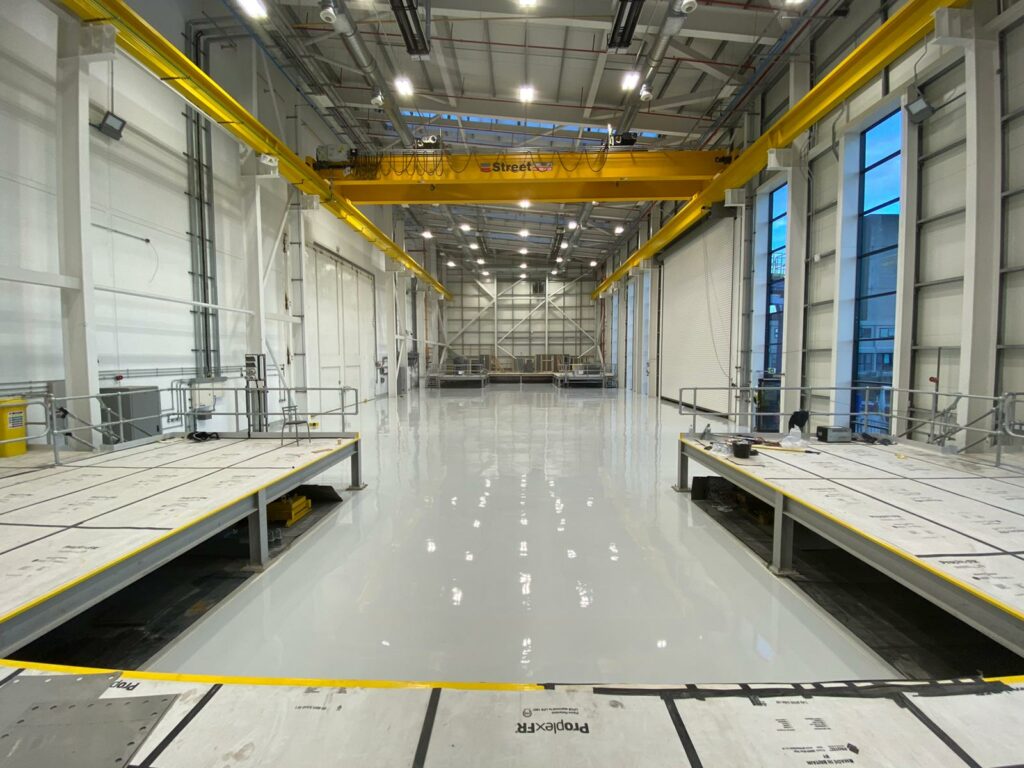
High-volume SMT (Surface Mount Technology) assembly lines work with electronic components that are highly sensitive to static, and a single discharge or stray particle can produce a faulty board. Cleanrooms are also highly controlled environments where airborne particles need to stay within defined limits. Floor seams are the main concern – joints in a floor can collect dust, moisture and cleaning residue, and joints in vinyl tiles or sheet can open or lift over time under wheeled traffic.
A seamless anti-static resin screed is applied as a liquid and cures into one continuous surface, usually coved up the wall to remove the hard corner. With no seams to harbour contamination, anti-static resin flooring is easier to clean thoroughly, and its electrical performance stays consistent across the whole area. We also deliver specialist manufacturing facility flooring for demanding production environments.
Benefits of Conductive Epoxy Floor Coatings in Data Centres, Server Rooms and Laboratories
Conductive resin systems provide controlled grounding for sensitive environments like data centres and server rooms, helping reduce the risk of static discharge. A conductive epoxy floor coating is connected to the building’s earth, typically through copper strips laid beneath the resin. Static generated by people and wheeled equipment then passes through the coating and away to earth rather than building up.
Sealing the floor offers a second benefit. Bare concrete sheds fine dust, whereas a resin coating binds the surface and is simple to keep clean. Combining ESD performance dissipation with chemical-resistant flooring can help protect both the resin system and the concrete substrate against accidental solvent or acid exposure in research facilities and laboratories. For specialist research environments, see our laboratory flooring solutions.
Tailoring Anti-Static Resin Flooring Across Key UK Industry Sectors
Copper Tape Earthing Grids and Substrate Preparation
Our ESD flooring installations begin with mechanical preparation of the concrete substrate and the application of an appropriate insulating primer. A grid of self-adhesive copper tape is then installed and connected to the building’s main Earth Bonding Point (EBP). Next, we apply a conductive primer containing carbon black particles to help create a continuous electrical pathway from the finished floor to earth.
For projects requiring a specialist conductive epoxy floor coating, we can specify the system around the required resistance and operating conditions. Our resin floor installers will also assess substrate condition and other installation requirements as part of the technical survey.
How Do Performance and Installation Costs Differ?
ESD resin systems typically require a higher initial investment than basic vinyl tiles or anti-static paint. However, the 15+ year lifespan of ESD resin screeds, in addition to their resistance to heavy machinery loads, mean that they deliver a significantly lower total cost of lifetime ownership. We assess installation costs on an individual basis, as preparation requirements, floor area, system thickness, electrical specification and detailing can all affect the final price.
ESD System Comparison Matrix
| System Specification | Electrical Resistance Range | Mechanical Load Capacity | Best-Suited Applications |
| Anti-Static Epoxy Coating | 10⁹ to 10¹¹ Ω | Medium | Warehouses, packing bays, general assembly |
| ESD Dissipative Resin Screed | 10⁶ to 10⁹ Ω | Heavy | SMT electronics, cleanrooms, laboratories |
| Conductive Resin System | 10⁴ to 10⁶ Ω | Heavy | Explosive atmospheres, data centres, specialist facilities |
Testing the Effectiveness of Existing Anti-Static Flooring
Existing ESD floors should be tested periodically because electrical resistance can change through wear, repairs, contamination or deterioration of the earthing network.
On-Site Surface Resistance and Body Voltage Testing
Surface resistance is measured using calibrated resistance meters (megohmmeters) and weighted 2.27kg electrodes. Point-to-point (R-p-p) and point-to-ground (R-p-g) testing establishes whether the floor remains within its originally specified electrical resistance range. Walking tests can also assess the voltage generated by team members wearing appropriate ESD footwear. All testing should be conducted using calibrated equipment, and documented against the requirements of the specified ESD system.
ESD Floor Audit and Compliance Checklist
Visual and Mechanical Inspection
Check for cracking, contamination, wear and damage to the resin surface.
Point-to-Ground Testing
Measure resistance between the floor and Earth Bonding Point at appropriate test voltages.
Body Voltage Testing
Assess charge generated by personnel wearing ESD footwear.
Earthing Continuity
Confirm copper tape connection points remain secure, clean and electrically continuous.
Frequently Asked Questions About ESD and Anti-Static Resin Flooring
Where can I buy certified ESD flooring systems in the UK with professional installation?
Certified electrostatic dissipative flooring systems should be specified and installed by specialist resin contractors capable of carrying out technical surveys and earthing verification. Impact Flooring supplies and installs specialist ESD resin systems nationwide across the UK. We select the correct ESD flooring system according to substrate condition, electrical resistance, traffic, contamination and your facility’s operational requirements.
What is the difference between anti-static flooring and ESD flooring?
Anti-static flooring is designed to reduce the generation or accumulation of static charge, while electrostatic dissipative flooring provides a controlled conductive pathway for existing electrical charge to dissipate to earth. The most appropriate specification depends on the sensitivity of equipment and the level of electrical risk within the facility.
Do anti-static or ESD resin floors require special footwear to work correctly?
Yes, personnel will normally need conductive or ESD-dissipative footwear or heel straps to complete the electrical pathway between their body and the floor. Standard rubber-soled footwear can act as an insulator and prevent static charges from dissipating effectively.
Contact Us for a Quote Today
If your facility requires controlled electrical resistance, reliable earthing and a durable resin surface, Impact Flooring can assess the existing substrate and operational requirements before recommending the best ESD flooring system. Contact our technical engineering team to arrange an on-site assessment, discuss ohmic resistance specifications or request an itemised quotation. Our specialist approach is designed to reduce ESD risk, protect critical assets and provide a durable flooring system suited to your specific operating environment.
A Smaller Colour Range, for a Technical Reason
Anti-static and ESD flooring relies on conductive additives in the resin, which limits the standard colour range compared with our other systems, usually to greys and darker neutral tones. That’s a trade-off for the electrical performance the floor is there to provide, not a limitation we’ve chosen for convenience. If you need a colour outside that range, talk to us early, because it may affect which conductive system we can specify.

Graphite

Slate

Steel

Platinum

Lincoln

Carmine

Coleman

Bondi

SERVICES
SOLUTIONS
SECTORS
REQUEST A CALLBACK
Contact Us
"*" indicates required fields
For bespoke industry flooring solutions talk to Impact Flooring today.
We offer free no obligation advice and can provide a price range on the first call.


 Impact House, 4 Short Street, Nuneaton, Warwickshire, CV10 8JF
Not ready to talk yet?